Digital and Commerce
Our Digital and Commerce Faculty consists of our highly successful Computer Science, Media, and Business departments. As a faculty, we are future focused - preparing for the careers of today and tomorrow. We are proud to be at the forefront, offering an innovative year nine programme, and a wide range of academic and vocational subjects including five different Key Stage Four qualifications and seven different Key Stage Five qualifications. 
Key Staff
- Mrs L Close - Head of Digital & Commerce Faculty, (Head of Media) and Designated Teacher
- Mr D Fido - Head of Computing, Second in Digital & Commerce, Digital Literacy Co-ordinator
- Mr J Slark - Head of Business Studies
- Mr J Higgins - Teacher of Computer Science
- Ms T Oxner - Teacher of Media
- Mrs R Rosewell - Teacher of Economics
- Dr T Tam - Assistant Head and Teacher of Economics
Subject Information
Digital-_and_-Commerce-Faculty (ID 1000)
-
Computing
Computing
Computing equips students for the digital world. Technology is all around us, and it is important to understand how it works, and the way it impacts on society. Skills gained include problem solving, logical thinking, and developing digital literacy.
Key Stage 3 - Years 7, 8 & 9
Curriculum Summary
The following links provide useful revision resources:
https://www.bbc.co.uk/education/subjects/zvc9q6f
Key Stage 4 - Computer Science. Exam Board: AQA
Subject content
- Fundamentals of algorithms
- Programming
- Fundamentals of data representation
- Computer systems
- Fundamentals of computer networks
- Cyber security
- Relational databases and structured query language (SQL)
- Ethical, legal and environmental impacts of digital technology on wider society, including issues of privacy
For details of how GCSE Computer Science is assessed, please click here.
Key Stage 5 - A Level Computer Science. Exam board: OCR
To view details of our A Level course please click here.
-
Business Studies
Business Studies
GCSE Business Studies (Full Course)
Course Outline
We follow the new AQA GCSE 9-1 specification for Business. This course will give you the opportunity to explore real business issues, and how businesses work. You will consider the practical application of business concepts and explore these through the context of events in the business and economic world. This GCSE Business course has two exams that will be sat in the summer exam series (May - June). This qualification is linear. Linear means that students will sit all their exams at the end of the course.
Subject content
- 1. Business in the real world
- 2. Influences on business
- 3. Business operations
- 4. Human resources
- 5. Marketing
- 6. Finance
Assessments
Paper 1: Influences of operations and HRM on business activity
What's assessed
• Business in the real world
• Influences on business
• Business operations
• Human resources
How it's assessed
• Written exam: 1 hour 45 minutes
• 90 marks
• 50% of GCSE
Questions
• Section A has multiple choice questions and short answer questions worth 20 marks.
•Section B has one case study/data response stimuli with questions worth approximately 34marks.
• Section C has one case study/data response stimuli with questions worth approximately 36 marks.
Paper 2: Influences of marketing and finance on business activity
What's assessed
• Business in the real world
• Influences on business • Marketing
• Finance
How it's assessed
• Written exam: 1 hour 45 minutes
• 90 marks • 50% of GCSE Questions
• Section A has multiple choice questions and short answer questions worth 20 marks.
• Section B has one case study/data response stimuli with questions worth approximately 34marks.
• Section C has one case study/data response stimuli with questions worth approximately 36 marks.
https://www.aqa.org.uk/subjects/business/gcse/business-8132/specification-at-a-glance
-
Media Studies
Media Studies
GCSE Media Studies - Eduqas
We live in a world where we are surrounded by media messages - from video clips on your phone to TV ads, 24-hour news channels and blockbuster movies. Media Studies seeks to make sense of them all - what are they trying to communicate, how do we know we have been influenced, does the media reflect reality?
By analysing a wide range of media products, you will increase your knowledge and understanding of communication, design, research, technology, and creativity.
You will also learn the production skills and processes to make your own media products including video editing, photography, design, and Photoshop. The course is 70% exam across two components and 30% coursework.
Course Content
In Year 10 you will be taught the key concepts of Media Language, Representation, Audience, and Industry, covering the following set texts: -
Advertisements: - 1950s Quality Street advert, This Girl Can and NHS 111
Film Marketing: - The Man with the Golden Gun and No Time To Die
Magazines: - Vogue and GQ
Newspapers: - The Guardian and The Sun
Video Games: - Fortnite
Radio: - The Archers or Desert Island Discs
Music Video and Artist promotion: - Taylor Swift, Stormzy and Duran Duran
In Year 11 you will make your own media product to fit a brief and explore the television industry with a focus on Crime Drama through Luther and The Sweeney.
A Level Media Studies - Eduqas
Course Outline
Students will be following the Eduqas course. On this course, students will study a variety of set texts and consider how context can have an impact.
-
Film Studies
Film Studies
GCSE Film Studies - Eduqas
Film is an important part of many people’s lives, drawing audiences into the lives of the characters and their narratives through powerful sound, cinematography and design. We’ll explore the history of Hollywood, the importance of independent films and develop your understanding of film and the impact that it has on differing audiences.
The qualification is split into three components:
- Component 1: Key Developments in US Film is an examination worth 35% of the grade. This unit demonstrates an understanding of three American films including two mainstream films and an independent film. Set texts are ET, Invasion of the Body Snatchers and The Hate U Give.
- Component 2: Global Film: Narrative, Representation and Film Style explores three further films including a global English language, a subtitled non-English language and a UK film. Set texts include Jojo Rabbit, The Farewell and Blinded By The Light. This is worth 35% of the grade.
- Component 3: The final component is the Non-Examined, or Coursework component, worth the final 30% of the grade. In this, students will be taught how to produce their own film extract or screenplay and will then evaluate their work.
Students will have access to camera equipment and a range of computer software including Adobe Premiere Pro in order to produce their non-examined assessment.
Key Stage 3 - Years 7, 8 and 9
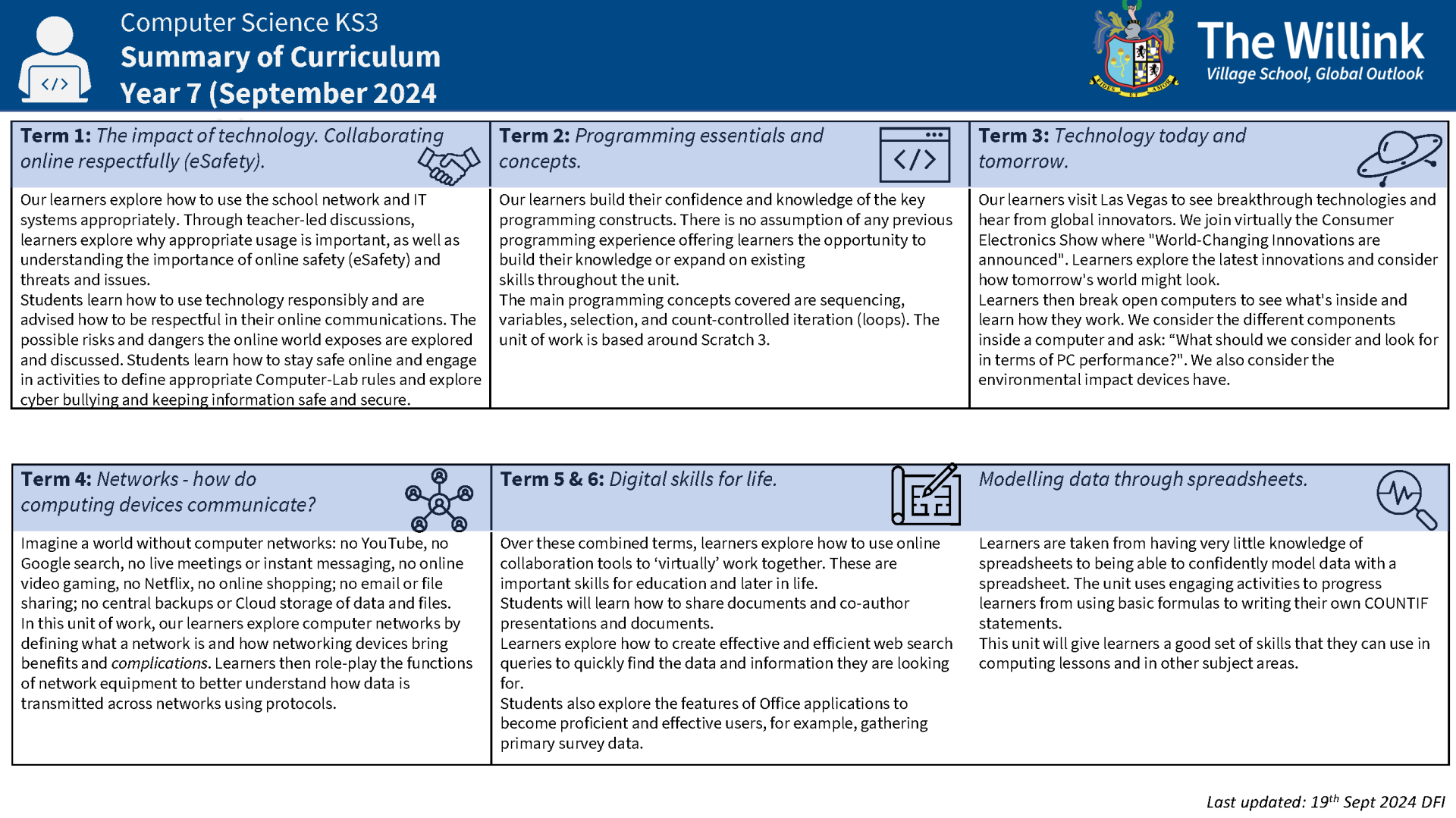
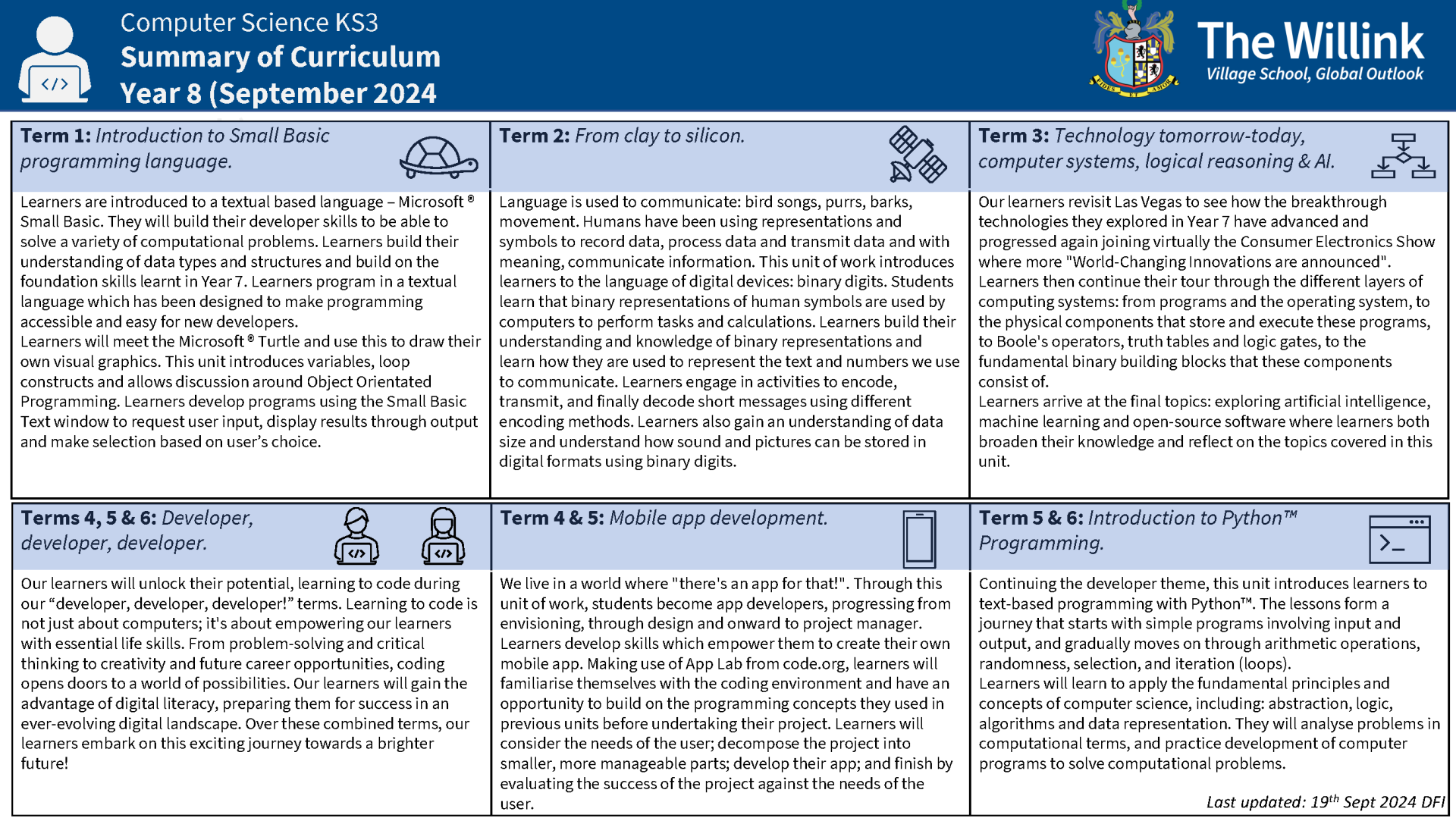
All students study Computing in years 7 - 9. The subject equips students for the digital world. Technology is all around us, and it is important to understand how it works, and the way it impacts on society. Skills gained include problem solving, logical thinking, and developing digital literacy.
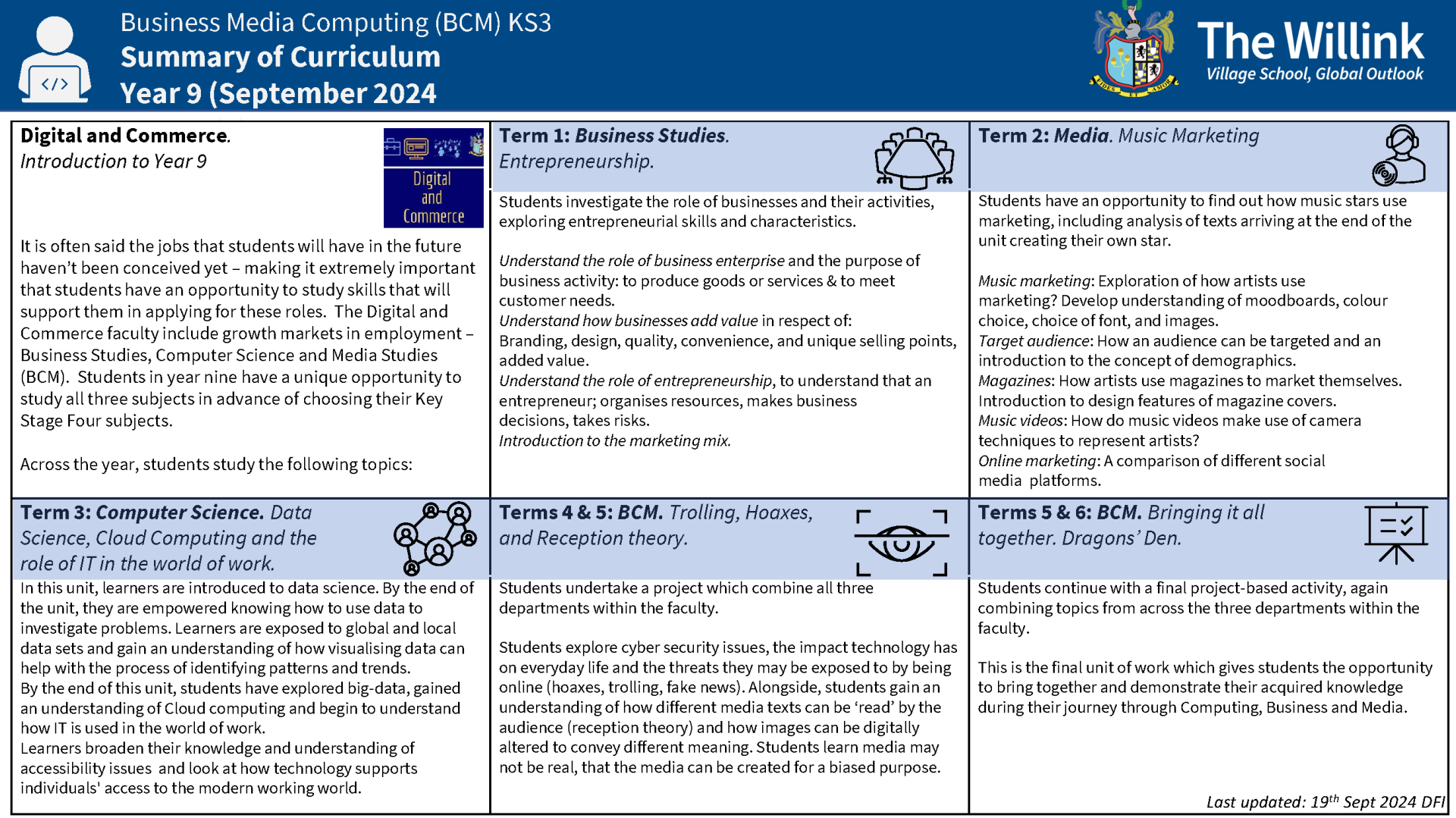
Curriculum Summary
|
Year 7
|
Year 8
|
Year 9
|
Digital & Commerce Milestone Assessments 2024/25
In year 9 students participate in the Digital and Commerce Carousel where they study Computing, Business Studies and Media Studies for a term each, helping them make their GCSE option choices.
Key Stage 4 GCSE - Years 10 and 11
Key Stage 5 - Years 12 and 13
Extra Curricular Opportunities
We are pleased to make further extra-curricular opportunities to stretch students, including a coding cub, film screenings, access to CISCO academy, the BEBRAS challenge, Raspberry Pi Foundation and speakers from within the industries. In the summer, the Media department holds a popular Showcase evening.
Last Updated September 2026